Backstage Pass — The Real Music Business banner: a tour laminate over a stage with road cases

Patrick Lamb · True stories from four decades on the bandstand

Backstage Pass

The real music business. Encouraging tales for the kids coming up.

The Real Music Business

The Backstage Pass series, in the order it ran.

  1. Episode 1LegendSept 15, 2026 · 12 min
  2. Episode 2The Barnacle’s AmbitionSept 17, 2026 · 2 min
  3. Episode 3Replaced by the BoyfriendSept 17, 2026 · 6 min
  4. Episode 4Billboard Purgatory and Conflict of InterestSept 29, 2026 · 14 min
  5. The Long CutThe Full Set / The Whole StorySept 15, 2026 · 13 min

The Mighty Muzak Cartel

Now playing in the lobby. Same acts, every floor, every year.

  1. Hold Music for the Whole IndustryHit Dogs HollerOct 2026 · 1 min

The Catalina Files

Art Good, JazzTrax, and the numbers behind the island.

  1. The Catalina Files · 1Breaking News from the Smooth Jazz UnderworldAug 28, 2026 · 2 min
  2. The Catalina Files · 2The Don of the AvalonSept 8, 2026 · 6 min
  3. The Catalina Files · 3Breaking News from Catalina IslandOct 5, 2026 · 5 min

The Real Music Business

Backstage Pass · Episodes 1–4 + the long cut

Episode 1Sept 15, 2026 · 11:48 PM · 12 min read

Legend

Encouraging tales for the kids coming up.

For all you kids coming up who think the music business is just going to help you — let me share a few encouraging stories, so you know you can make it.

"LEGEND"

Kids, gather round. Today's inspirational story is about the power of dreams, the dignity of hard work, and a seventy-something-year-old man throwing luggage.

For eighteen years, I worked in the band of a legendary artist — let's just call this individual "LEGEND" for entertainment purposes. Eighteen years. That's longer than most marriages. That's an entire human being who can now legally vote. And honestly, eighteen undersells it — I first played on one of his records when I was still in my teens, alongside guys like Tom Scott. Which means this man has known exactly who I am for most of my natural life. Hold that thought, kids — it's going to matter later. And I wasn't just playing the horn — oh no. I played on his records. I wrote hundreds of horn charts. I rehearsed hundreds of horn sections. I hired the players, sent the music, chased down the guys who don't answer texts (all of them — they're musicians), and ran the entire operation so that when the great man floated on stage, everything behind him just worked. Sound system melting down mid-show? I fixed it. Needed gigs? I personally hustled him six figures' worth of bookings. My connections. My phone calls. My name opening up at least a few doors.

Total thank-yous received in eighteen years: zero. But hold on — that's not the story. That's just the ambience.

See, around year sixteen, something terrible happened: my own career started doing okay. Nothing outrageous. Incrementally less tiny, let's call it. You know — six, seven, sometimes eight of my own fans showing up to his shows. A groundswell. Practically Beatlemania. Some nights the crowd would even give me a little love. I know. The audacity of me.

And that, kids, is exactly when LEGEND deployed his secret weapon.

He started introducing me as "Pat." At concerts. Into a microphone. To paying audiences.

Now, my professional name is Patrick Lamb. It's on my albums. It's on the posters. It's what my mother — a woman with considerably less ego than this man — has managed to say correctly for decades. And I took the legendary artist aside and told him, plainly and privately: I really hate being called that — please don't do that. Then I told him by text. Then in a formal email, cc'ing his manager, like I was filing paperwork with the federal government. Six separate times: my name is Patrick Lamb. I'm a grown-ass man, not a kid.

For context on the difficulty of this task: Smokey Robinson mastered my name. Bobby Caldwell — nailed it. Even Jeff Lorber — rude in ways only Jeff Lorber can be — got my name right for several tours. Diane Schuur got it on the very first night — and then zeroed in on a sweet, affectionate nickname for me that became our own inside joke. Because that's how nicknames are supposed to work, kids: both people are in on it. She still calls me to this day. Four decades in this business and virtually every human I've worked with has cleared this bar, which, to be fair, is on the floor.

But this legend? Eighteen years of service, six formal requests, and he strides to the microphone in front of a paying audience: "Pat and the Boys!" … "It's Pat on Sax!" A man who writes eleven-minute songs about the nature of God could not locate the last four letters of my name.

"Maybe he forgot," you're saying. Kids. Sweet, innocent kids. Around this same time, the man began flicking bottle caps near me. During concerts. On stage. Mid-song. A legend of popular music, sniping bottle caps to land at his saxophone player's feet like a bored eighth-grader in the back of study hall. My wife was at one of those shows and saw it from the audience. Her review, verbatim: "What the fuck?" A concise woman. East Coast Italian, kids — she had the Legendmeister sized up years ago and did not give two shits about the mystique. The robes, the incense, the eleven-minute songs about the soul — none of it ever got past her. That's show business, honey.

And the needling wasn't confined to the stage, because with this man nothing is ever confined to the stage. Some context: we'd had LEGEND over to our house. Big evening. The wives hit it off beautifully — his wife and mine became genuine friends, the best thing to come out of the whole era. The legend ate our food. Ate well. Sat at our table, under our roof, being fed and hosted and treated like family. Fun fact about that visit: one of the first things he said upon seeing our home overlooking the gorge was to ask what it cost — and to observe that we'd probably need to sell it. As a greeting. Most people try "what a lovely place." He went straight to the appraisal. A romantic. A jealous king of a tiny hill. Unfortunately there are a few in this business.

Then, at the next gig, LEGEND sidles up to me with something clearly weighing on his mind. Was it "thank your wife for that dinner"? Don't be ridiculous, kids — you know this man by now. No. He wanted to know why my wife colors her hair. He didn't care for the color, you see, and felt I should know. I'm just asking for a friend but what heterosexual man asks some shit like that. I mean i don't know. Nothing against anybody who goes whatever way you want to go but i'm just saying?

A few notes for the record. One: she doesn't color her hair. It's natural. Every strand. So as a critic, he's not just rude — he's wrong, which for a perfectionist has to sting double. Two: even if she did — what? Three — and I ask this genuinely, scientifically: what manner of man notices, catalogs, and then reviews another man's wife's hair color? To her husband? At work? I'm just asking for a friend. The friend has since polled every man he knows. The results are in, kids: none of them. No man does this. Most men, kids, could not report the color of their own bathroom towels under oath. This man showed up to work with notes. On my wife's head. The data is unanimous, and the data is concerned.

And it wasn't a one-off, because nothing with this man is a one-off. On two separate occasions — in the band van, in front of the guys, apropos of absolutely nothing — he brought up how wonderful it was to run into my ex-wife. Twice. Same bit, two performances, waiting each time to see if it would get a rise out of me. That's not small talk, kids. That's sonar. He's pinging you, listening for a reaction to bounce back. The correct response is the one I gave both times: flat water. Nothing to echo off of.

So one night in Chicago, he does the "Pat" routine again, and I decided to treat myself. I grabbed the mic and said, calm as a golf announcer: "Hey, 'LEGEND' — it's Patrick."

One little sentence. Eighteen years of loyalty, and it turns out the whole thing was balanced on one sentence like a house of cards on a wobbly table. Here's what it bought me.

After the show: a barrage of texts from LEGEND. Not "hey, let's talk this out." More the genre of texting you'd expect from a teenager whose Wi-Fi got taken away. So I did the adult thing — the thing they teach you: go talk it out, face to face. I walked to the dressing room to shake hands and move on. Eighteen years, right? Surely we can survive one conversation.

I walk in. I say, "Hey — we need to talk about a few things." I head to the right and sit down on the couch. Civilized. Two adults, a couch, a conversation. And as I'm sitting down, the man picks up his suitcase. Lifts it over his head — a full clean-and-jerk, honestly impressive for his age, cardio clearly still there — and slams it down on the table.

Then he lunges across the room and puts his hands on me.

At which point his own brother — who is also his manager, because in this operation the org chart is a family tree — has to physically grab him and haul him back.

And kids, I want to be honest about what I felt in that moment, because it's instructive. Not fear. Not anger. Pure, scientific disbelief. I actually started laughing. A legendary artist, a man in his seventies who sings about the soul, being restrained by his brother in a dressing room, because his saxophone player of eighteen years asked to be called by his own name. I never moved toward him. I said exactly one thing: "Are you serious? This is where you want to take this?"

His majestic reply: "Get out!" Just like that. A tiny king, banishing a peasant from a dressing room with a fruit tray in it.

Oh, but there's a coda, and it's my favorite part. Twenty minutes later, word reaches me that he's at the band table, holding court, workshopping his version of events for the room. So I walked over, pulled up a chair, and corrected the record in front of everyone — at which point the brother, a man whose forearms were still warm from restraining his sibling, looked at me with a straight face and informed me that I have an anger problem.

The brother. Who had just finished holding back the other guy. Like a lifeguard climbing out of the pool to tell the dry people they swim too much.

David Goldblatt was sitting to my left and offered, "Well, maybe he just said it affectionately." I said, "You know what, David, from now on instead of Goldblatt I'm just going to call you Dick. Affectionately, of course. That work for you, bruddah? He just had to sieze the moment and suck up. Just could not resist.

And that was that - I was fired or quit depending on what roach infested mighty middleman muzak mouse is peddling the story too upsell their artist or downsell an independent getting a piece of that pie that week — some guys' entire catalog, kids, is other people's exits. It's the only inventory they carry.

Now let's balance the books, because every good story needs an accounting. Over roughly a decade, I personally generated about $100,000 in bookings for this man. And I don't mean "I mentioned him at a party once." I mean gigs that exist because I made phone calls. The Portland show? My hustle. The Cincinnati date at a storied venue? My direct connection. The jazz series out West? Me. The festival run? Also me. Promoters took my call because it was my call — and then wrote checks with his name on them. Fun math corner, kids: a booking agent takes ten to fifteen percent for this service. My fee? Nothing. I did it for exposure — and I was indeed exposed. To the elements. What I received instead was the industry-standard payment plan known as a thank you — two words, zero dollars, no shipping required. It never arrived. Not after Portland, not after Cincinnati, not after any of them.

Speaking of that jazz series out West — the one I built. My concept. My relationships. My room, with my fingerprints on every board. I brought LEGEND in to headline it. Hired him. Hired his guys. So naturally, when the dates came together, the saxophone chair in the series I created went to… another player. Arranged behind my back. Nothing against the player — wonderful musician, a friend even. This is about the mechanics. Read it again slowly, kids, because it's almost elegant: I hired the bandleader. The bandleader then un-hired me. From my own gig. That's like inviting a man to your birthday party and having him meet you at the door with a clipboard: "Sorry, buddy. Not on the list." It's my party. "Sure it is. Not on the list." Was there an explanation? Oh, there's always an explanation. This man has never once in his life been short an explanation. A story arrived, fully produced, with a beginning, a middle, and a moral. I didn't believe a syllable of it, and neither would you.

And then there's my favorite entry in the ledger. A while back, I re-recorded one of his hit songs. A tribute. Eighteen years inside a man's music, it gets in your blood — sue me. (Actually, don't. We'll get there.) I did this thing by the book. Told him I was recording it. Sent him the track months in advance. Released it properly — full credits, every detail, every dotted i and crossed t. Then I sent the finished record to LEGEND and his brother. And kids — the record charted. His song. Back on the charts, decades later. Honored. Lovingly. Successfully. By a guy who stood next to him playing it for two decades. The response — from either of them, of any kind, ever? Nothing. Not a word. Not a text. Not a thumbs-up emoji — and kids, the thumbs-up emoji is free. It comes with the phone. The silence was so complete I checked my own email to make sure it still worked. It did. It works great. He just never used it.

And that, kids, is the whole business model in one image: these guys own the bread factory but don't let them see you get a crust of bread. Eighteen years of baking and I never got a roll. So I did what any sufficiently encouraged person would do. I'm out.

THE FILE I'M NOT OPENING TODAY

Now. Are there other questions? Kids, there are other questions.

I'm not going to raise them here. This is an encouraging series, and I'd hate to discourage anybody. But you should understand that a run like this generates a filing cabinet. And in that cabinet there are folders. And a few of those folders have dust on them for a reason.

For instance — and I am describing the shape of a question, not answering it — one might wonder what happens when a photographer shoots a great deal of work for an artist, and that work allegedly turns up on promotions and on merchandise, and the photographer allegedly never sees a dime. One might wonder that. I'm not saying it. I'm saying a reasonable person, standing at a respectful distance, could wonder it. Hypothetically. In the privacy of their own home.

One might also wonder — purely as a thought experiment — what an ordinary person would make of a certain text thread from a certain van ride, between the legend and certain members of the band, if you handed them the phone and asked them to read it back out loud. No commentary. Just reading. I suspect they'd have a question or two about the tone. That's an opinion. That's all it is: the opinion of a man who was present and can read.

We are not opening that folder today. Today is about names and luggage.

But the folder exists. It is labeled. It is alphabetized.

And kids — I have excellent handwriting.

Encouraging lesson

You can give somebody two decades of loyalty, hundreds of charts, and a hundred grand in gigs, and it can still end with a septuagenarian being peeled off of you in a dressing room. Dream big, kids!

It's Patrick, by the way. Patrick Lamb.

New episodes on the way.

Back to the index

Episode 2Sept 17, 2026 · 12:36 AM · 2 min read

The Barnacle’s Ambition

Honoring “The Sub,” whose ambition perfectly mirrored a barnacle.

Gather round for Episode Two, where we celebrate the majestic creature known as "The Sub." I’m not talking about the 99% of honorable pros who read their music and do their homework. No, today we are honoring a man whose ambition perfectly mirrored a barnacle: quietly, permanently clinging to something that was actually going somewhere.

Picture a guy wearing shirts with their own weather systems and shoes suggesting his feet are actively considering a divorce. Looks don't matter if you can play, but as you'll see, playing wasn't exactly his primary talent.

The Platinum Customer Service Package

As the guy running the horn section for eighteen years, I practically spoon-fed this man the gig:

The Blueprint: Charts and backing tracks delivered a full 30 days in advance.

The Hotline: My personal cell number, glowing like a beacon of "please, for the love of God, ask me anything."

The Sandbox: A live, in-person rehearsal designed specifically to work out the kinks.

The Golden Rule: One simple instruction to flag any issues at least a week before the show.

His response to this buffet of open doors? A breathtaking masterclass in absolute silence.

The Tactical Grenade

He held onto his one tiny chart question for an entire month. He bypassed texts, calls, and rehearsals just to pull the pin on that grenade at the exact millisecond Mr Legend himself stepped on stage. It wasn't confusion; it was Broadway-level choreography designed to manufacture a crisis and make me look bad. If his sight-reading was half as good as his room-reading, he’d be Coltrane.

When I reasonably suggested to management that we skip his services for the next run, they immediately hired him back. Why? Simply because they knew it would annoy me. Ah, the strategic depth of a middle-school cafeteria.

The Royal Wedding of Nothing

To really sell the drama, SUB took to the internet to announce THE SUB’s promotion and invite to ‘JOINING THE BAND’. It was a digital wedding, complete with staged photos, cheesy grins, and a lot of just wow.

And honestly, looking at the photos, you can see exactly why LEGEND is so utterly thrilled with the arrangement. There is an undeniable comfort for a star in standing next to a guy whose primary aesthetic contribution is making you look fifty percent more glamorous just by existing in the same zip code.

They really do complement each other perfectly. Like a luxury sports car parked next to a trusted, high-mileage minivan. LEGEND has never looked happier, beaming with the total, serene security of a man who knows the audience will never, ever be distracted by the horn section's raw sex appeal.

But as the queasiness of scrolling past that wedding album faded, it turned into pure, unadulterated joy. Because here is what THE SUB actually won: he clawed, schemed, and connived his way to the captain’s chair of a ship permanently parked at the bottom of the ocean. He successfully secured a chair in a band that doesn't actually play. No travel, no soundchecks, no load-ins. Just pure, uninterrupted availability.

Congratulations on the marriage, Mike MacArthur. Given the tour schedule, it's the perfect union and a gig you can absolutely crush without ever having to leave your living room.

Warmest regards,

Patrick Lamb

Back to the index

Episode 3Sept 17, 2026 · 8:58 PM · 6 min read

Replaced by the Boyfriend

How I built the first version of The Players — eight musicians, five airlines, every chart, every dollar — and got replaced by the boyfriend. (Real life Spinal Tap.)

For anybody coming up who thinks the music business is going to look out for you — a few encouraging stories.

It may not be common knowledge, so let me put it on the record. I put together the first version of The Players. I made every call. I booked every flight and paid for them out of my own pocket. I wrote the itinerary. And I did all the charts.

Here's how that went.

FIRST QUARTER, 2022

I had just moved to Florida, which in this business means you are a brand-new person with a brand-new area code. I was touring constantly but meeting new people in Florida and networking. So you do the only thing there is to do. You sit in. You shake forty hands, and you drive home at one in the morning calling it networking.

At one of those, I met a woman with a Florida management company named Kim and her boyfriend Jimmy. Business cards. Rooms, buyers, boundless enthusiasm, and a timeline stuffed with aggressively photoshopped memories, providing exactly enough secondhand clout to make her feel famous in her own living room.

We got to talking and I pitched her the real thing. Not a tribute band. Not five guys in wigs playing the horn parts on a keyboard. The actual men who made those records. One night. One room. Let the place come apart.

She loved it. Of course she loved it. Loving it is free. Everybody's got an idea and implementation is the key.

Then somebody has to go and do it. That was me.

THE FIRST GROUP — MAY 14, 2022

I called Bill Champlin first, because that's the only call that matters. If Bill says yes, everybody says yes. If Bill says no, you are producing a very expensive karaoke night. Two Grammys, wrote "After the Love Has Gone," sang lead on two of the songs we'd be playing, one of the great voices in American music. He said yes.

After that I arranged everybody:

Jeff Coffey — fronted the band, sings those impossible parts and plays bass at the same time, which is a form of witchcraft. Tris Imboden — nearly thirty years in that drum chair, plus all those years with Kenny Loggins, one of the most musical people I have ever stood next to. Keith Howland — twenty-five years of those guitar solos, note for note, night after night. Cisco Dimas — trumpet, a monster. Miles Fielder — horns. And me on tenor, running the music and running the trip.

Every one of those men was a class act. Answered their phone. Answered their texts. Showed up early. No attitude, no diva nonsense, no drama. Kind to everybody in the building and played like the place owed them money. I would pick up the phone for any of them tomorrow.

Which is exactly what makes the rest of this funny instead of sad.

WHAT "I PUT IT TOGETHER" ACTUALLY MEANS

Since nobody in management has ever had to find out, here it is.

Eight travelers. Five airlines. Two arrival days. One guy landing at 10:47 at night. Eight hotel rooms and eight confirmation numbers. One itinerary — venue, address, load-in, artist arrival, sound check, doors, downbeat, lobby call, every flight number, every confirmation code, every phone number on the trip — typed by me, put in a Google Doc so it lived on everybody's phone, then pinned into a group text so nobody could tell me later they didn't know.

Charts pulled. Charts fixed. A Dropbox built for the horns with notes on exactly what to update before downbeat.

And I paid for all of it. My money. The plane tickets, the rooms, the whole build. No advance. No budget. No deposit from the management company with the business cards. My own bank account, on a bet that the room would go crazy and the thing would become something.

It did become something. Hold that thought.

THEN, AT THE LAST MINUTE

With everything locked, the small ask. Kim would like to send someone up with the band.

Terrific. Production contact? Advance man? Somebody to work the room?

No. Her boyfriend Jim.

Does he play?

Tambourine. And some background parts.

Nobody needed him. Nobody had asked for him. There was no hole in the band shaped like a tambourine. But she wanted him up there, so up he came.

I want to be precise here, because precision is the only defense you have in this business. The tambourine is a real instrument. There are tambourine parts on records you love. There are tambourine players who can do things I cannot do.

This was not that. This was a man holding a tambourine at an event, occupying a position on the stage that nobody present could have defined out loud if you'd offered them money — including him.

When a role is that ambiguous, the industry solution is titles, and titles are free. He received Hospitality. Then, because one title wasn't holding, he also received Transportation.

His documented contribution, in his own words, in the group text: when you land, get your bags, go outside, call the driver back, and tell him what gate you came out of.

All of which was already on the itinerary. Which I wrote. After I bought the plane tickets he was describing, and booked the hotel he was pointing at. He was, in effect, reading my own document back to the people I had flown in on my own money — and being thanked for it.

He also arranged a light lunch. I'm told it was fine.

SHOW DAY

Four hours before doors, the buyer requests a song that isn't on the set. Not a deep cut. One of the big ones. Nobody has the chart. Nobody agrees on the key. And the keyboard player — the man who was actually on the record — reports that he never played piano on that one, only strings, and wonders aloud whether this might have come up while he was at home, sitting near a piano.

So that was my afternoon. Baltimore hotel room, phone in one hand, wrong key in the other, chasing a chart across three time zones for a tune nobody planned on.

Nobody sees that part. Nobody is supposed to. That's the gig.

Doors 4:30, because nothing says rock and roll like a 5:30 downbeat. Sixty minutes. The room came apart anyway. That band could level a building in forty.

THE MORNING AFTER

The texts roll in. Everybody glowing. The manager writing that the feedback is insane, that she is grateful for everyone involved, that we should take this thing out on the road.

And then one of the legends types out the thank-you note to the whole group and hands the credit for the entire operation to the tambourine:

"Great at herding cats."

That's the review. That's the notice.

I'm not bitter about this, in exactly the way that people who announce they're not bitter about this are famously not bitter about this.

THE ENCOURAGING PART

The show did go out again. It became a thing. It got dates.

And the man who had the idea, made the calls, hired the band, wrote every chart, built the itinerary, booked eight flights on five airlines and paid for the entire first one himself — was not on it.

Replaced. Out of the group I built. Because the boyfriend needed somewhere to stand, she wanted him standing there, and there is only so much stage.

The tambourine was on it. The tambourine was, in fact, running it.

There's a film about this. People think it's a comedy. The girlfriend takes over the management, brings in her own vision, consults the stars, and the band ends up billed under a puppet show while an eighteen-inch Stonehenge is in genuine danger of being crushed by a dwarf. Everybody laughs.

It isn't a comedy or Spinal Tap although it sounds like I know. It's a documentary with better catering.

So — make the calls. Hire the legends. Write the charts. Fix the key with twenty minutes left. Front the money. Build the document that makes the entire night possible.

Then go outside.

The van is outside.

P.S. — I still have the itinerary. Every name, every flight, every confirmation number, every hotel line, every receipt. Receipts are the one thing in this business nobody can take off the list.

Back to the index

Episode 4Sept 29, 2026 · 10:31 PM · 14 min read

Billboard Purgatory and Conflict of Interest

Smile, nod, and write the check. To be clear, there’s no conflict of interest between Adam and Butler. There’s just interest, and a firm agreement about whose it is.

Welcome back to Backstage Pass. A little housekeeping this week: one month into this campaign, I fired my record promoter, Adam Leibovitz of ASL Music Media & Promotion, who is also VP Promotion/A&R at Innervision Records. The termination letter is below.

To every programmer who got "Food For the Soul": thank you for listening. Some of you will keep spinning it. It's great music, and I'd rather stand behind what I believe than stay quiet. That package is no longer available.

And a word to everyone else listening. If you don't believe in free speech, in people saying what they actually think, passionately and in public, you probably won't like me. That's fine. Find somebody else. But if you're one of the ones who works behind the curtain, you know who you are. You preach love and tolerance right up until someone disagrees with you. Then the love runs out and the knives come out, quietly, behind closed doors. You won't face anyone. You won't answer anyone. You just work the back rooms until they're gone, and then you call yourselves the good guys.

The All-Inclusive Resort Package

Here's what more than twenty-five thousand dollars in smooth jazz radio promotion with ASL bought me. Not a hit. Not a Top 10. A reservation at the lovely Billboard Purgatory Resort & Spa, chart positions thirty through forty, where the view never changes, checkout is never, Innervision Records artists consistently soar to #1, and the only thing that moves is your checkbook.

I've stayed there more than once. The brochure always promises the penthouse. Just a little more money and one more month. I always get the room next to the ice machine.

The Man Who Asks Questions

In fairness, I'm an anomaly. I read the spins report. I compare week over week. I track adds, drops, and who actually played the record versus who said they would. I build my own charts and graphs, and I ask every question.

They hate that.

In my opinion, the ideal ASL client, at least one who isn't on the Innervision label, sits quietly. Everything is always up. Even when it's down. Smile, nod, write the check, say thank you. Ask one direct question about the numbers and watch the temperature drop. Ask a second and you're promoted to "emotional artist," which is industry shorthand for "please stop being a person with a calculator." The numbers go down, you're told everything's up, and the emails asking why sit unanswered. It's a weatherman in a hurricane, hair sideways, assuring you it's a beautiful day for golf.

Adam will, of course, argue that my social media may have affected how I'm received. But if I had a dollar for every person who has called, emailed, texted and messaged me in support... Most radio professionals can set their feelings aside for the day, listen to the music, and not blur the lines with an artist's personal politics.

Three things I can't accept. First, that the metric questions I sent didn't call for an answer. Second, describing a song's downward turn as "encouraging" when four measures are down and one is up. Third, the complete absence of any response or accountability to business emails.

The Point Spread

Here's what finally clicked. Adam isn't just an independent promoter. He is also VP Promotion/A&R at Innervision Records, Blake Aaron's label. Ah yes, the industry's best-kept secret: your promoter's other job is competing with you. It's not a conflict of interest. It's "synergy." That's what they call it when you pay and they win. The dirty little secret isn't really a secret. It's more of an open-door policy, with the door conveniently facing away from you. Nothing says "I've got your back" like working for the label you're competing against. It's the conflict of interest that comes free with every promotion package. No extra charge. Well, twenty-five thousand extra. And Blake Aaron's main agent is Steve Butler, from Mighty Grifter Corp, Mighty Muzak Cartel, aka Mighty Extortion Corp from my experience.

Walk it through with me. The promoter you pay also runs promotion and A&R for a label whose artists are chasing the same handful of add slots on the same shrinking chart you are. In my opinion, and my attorney's, that's a built-in conflict of interest. So whose record gets the extra phone call on a slow Tuesday?

It isn't a conspiracy. It's a point spread. And when you're not on the house's team, you're the line they're betting against.

Free Speech, House Rules

Last year Adam would go on for hours about politics in Israel. Hours. I listened and I supported him, because I believe in the First Amendment. I love the arrangement where he gets to use Facebook as his own personal political megaphone, while I'm expected to take a strict vow of silence to protect his delicate radio sensibilities. Free speech is supposed to work like this: you say what you believe, and I listen.

Turns out it only works in one direction.

Understand this about radio: it's a very, very small group. A few dozen hardworking, great programmers and a handful of great promoters. Some truly believe in the First Amendment. I would say most.

Adam also called to let me know he'd had "considerable discussions" about my attacks on radio personnel. Fascinating, since there were none. So I said, "Show me the receipts." Did he ask anyone for receipts? No. So he sat through a full trial with no evidence, no witnesses and no defendant, and still reached a verdict. What is this, seventh grade? Should I check my locker for a note? Impressive work. It's just filthy and disgusting.

If my success has to be bought with my silence, I'm not for sale. Not today, not ever. There is no chart position high enough, and no playlist wide enough, to buy the silence of a free man.

Checking Out

So I'm checking out of the resort. New promotion, new team, same record, and the same habit of asking every question, because that's the only way you ever find out who's really working for you.

"Food For the Soul," co-written with James Lloyd of Pieces of a Dream, deserves better than purgatory. So does every independent artist who's ever been told to sit down, smile, and stop asking questions.

Listen here: https://orcd.co/foodforthesoul

Warmest regards,

Patrick Lamb

The Letter · as sent September 29, 2026

PATRICK LAMB PRODUCTIONS

SEPTEMBER 29, 2026

Adam Leibovitz, President

ASL Music Media & Promotion

28541 El Peppino, Laguna Niguel, CA 92677

adam@aslmusicmedia.com

Re: Notice of Termination of Radio Promotion Services — "Food for the Soul" — Effective Immediately; Notice to Preserve Records

Adam,

Patrick Lamb Productions terminates the engagement of ASL Music Media & Promotion for radio promotion of "Food for the Soul," and any other services, effective immediately. This letter sets out the grounds, states what I require from you, and puts you on notice that litigation is under serious consideration.

1. THE ENGAGEMENT AND THE DUTIES THAT CAME WITH IT

A promoter who pitches an artist's record to programmers on the artist's behalf is the artist's agent. An agent owes the principal a fiduciary duty of undivided loyalty; a duty not to act for, or assist, a party adverse to the principal or a competitor of the principal; a duty of full disclosure of every material fact bearing on the engagement; and a duty to perform with the care, competence and diligence of a professional in the field. Those duties attach whether or not the word "fiduciary" was ever spoken between us.

2. CONFLICT OF INTEREST AND BREACH OF THE DUTY OF LOYALTY

You have told me directly that you co-own Innervision Records with Blake Aaron; your public title there is Vice President of A&R and Radio Promotions. In that capacity you promote Innervision singles to the same Billboard and Mediabase panels, the same programmers, and the same limited add slots that you were paid to win for my record. Assisting a competitor for the same slots during the engagement is a breach of the duty of loyalty.

Steve Butler is Blake Aaron's principal booking agent from Mighty Grifter Corp or Mighty Shakedown Inc. or Mighty Muzak Cartel depending on who you ask — a matter of public knowledge — and books other Innervision artists; he is commercially important to the label you co-own. Mr. Butler has publicly attacked me. You have supported him. An agent may not act for, or align himself with, a party adverse to his principal while continuing to accept the principal's fees. You did not disclose that alignment to me, and I did not consent to it. Whatever I knew of your Innervision title, I was never told that my paid representative was standing with the man attacking me.

The incentive is plain. My continued presence created friction with a relationship that matters to your label. It is my opinion, based on the facts set out in this letter, that it served you and Mr. Butler for me to be gone — whether by direct exit or by letting this record underperform — and that this is a good deal more likely than the alternative explanations you have offered.

The fees I have paid you to promote my records exceed $25,000. The remedy for an agent's disloyalty, in both California and Florida, is forfeiture of the compensation paid during the period of disloyalty, together with damages caused by it.

3. NON-PERFORMANCE

I supplied definitive, comparable metrics and asked specific questions about them. On each occasion the response was different information — related, but not an answer. Declining to engage with the client's own data is a failure of the duty to account and to perform.

Week-5 report (received September 28, 2026), your framing "some good signs." The same-week comparison: Billboard debut at #86 in week 5, against Everybody Get Up #55, Mint Condition #52, I Just Wanna Stop #58 and Horizon Line #65, each of which charted by week 3 or 4 — the latest and lowest Billboard entry of the five singles you have worked for me. Mediabase: no position in week 5; stations 9 to 7; every prior single had a position by week 3. SmoothJazz.com: #84 to #87, stations 19 to 16, spins 70 to 67. SJ Network: #94 to #98. RadioWave Groove Jazz: frozen since week 2. One debut, four declines.

This is a strong record. In my opinion, based on the facts in Sections 2 and 4, your conduct contributed to its underperformance. You were paid to contribute to its progress. That is the opposite of what you were engaged to do.

4. THE RELEASE DATE AND YOUR HANDLING OF BUSINESS CORRESPONDENCE

My email of November 17, 2025 ("Release Timing and Planning") set out the plan in writing: two singles a year, one in January or February and one in July, and stated why a late-year release does not work for my business. No reply was received. We then spoke by phone; you indicated there was little room in July, and my recollection is that we agreed on August 1st. You will dispute that recollection. My intention and my business plan are documented in writing to you; your non-replies are documented as well.

Eight subsequent emails carried an August 1st radio date, four of them on a single day. None drew a correction, a counter-date, or a reply. The first written appearance of "8/31" from you is August 8, 2026 — after my date had passed and after the record was already out to distribution on the date I had communicated.

Your explanation, stated to me directly, was: "I am NOT proofing them Patrick. That's for your publicist or PR guy to do." A promoter who receives his client's release date and does not read it is not declining to proofread; he is declining to do the job. The email carrying the date is no different from the email carrying the artwork, the ISRC or the one-sheet — it is the information the work depends on, and you opened those. An agent who holds a different date owes the principal that fact, in writing, in time to act on it. You did not provide it. I asked for the email or text in which you communicated an alternative date. None has been produced.

5. UNSUBSTANTIATED HEARSAY IN PLACE OF REPRESENTATION

You told me that other radio promoters had called you regarding my personal posts, and that, specifically, Lynette White of SiriusXM asked you whether you chose to promote this record "before or after you saw Patrick's posts," and "why would you promote this record." You relayed these to me without pushback, without a single receipt, and without identifying anyone else. You have not produced documentation of any of it.

Either those conversations occurred, in which case your duty was to defend your client to the industry and you did not; or they did not occur, in which case they were a means of pressuring me to stop expressing my opinions. Neither is consistent with the duty of an agent to act loyally for the principal's benefit. Whether they occurred is something only you know, and I regard it as improbable that multiple grown professionals telephoned you about my social media. If they did, the conduct is infantile and they should be ashamed of themselves — and so should you, for taking the calls and carrying them back to me. Your job was to answer them on my behalf.

You understand free expression perfectly well when it is your own. Last year you spent hours sharing your political views with me. I listened, and I supported your right to say it — I share much of what you believe. Yet when I exercised the same right, you delivered complaints about my posts instead of defending my record. In this business, an artist who speaks his mind is shut down and cut off from the work; an agent's job is to stand between his client and that, not to carry it to him. A standard of free expression that applies to the promoter but not to the client who pays him is not a standard. It is leverage.

Your responses to legitimate business questions — "artists are emotional," "fragile egos," "nobody cares," "oh, you use AI," and the characterization of a link I sent as "passive-aggressive" — answer nothing. They are the stock lines of the middleman who cannot play a note, deployed to discount and marginalize the artists who pay his bills. They are noted for the record as the responses a paying client received to specific, documented questions about the work he was paying for.

Your willingness to repeat third-party gossip about your own client, to your client, without shame, reflects an intolerance for independent thought and for the sharing of information unless it agrees with you. I would have been ashamed to admit to that kind of conversation. What statistics and facts? How dare I share those.

6. TERMINATION AND DEMANDS

There is no operating agreement between us and nothing bearing a signature, so there is nothing to unwind. I expect that what follows will be the usual — talk among the people who run this business — and I have made my peace with that. It was going to happen with or without this letter; the difference is that I am no longer paying for it. Accordingly:

Termination. The engagement ends today, September 29, 2026. No further services are authorized and no further fees will be paid. Any invoice for any period after this date will be disregarded.

Cease representation. Cease all servicing, representation and communication to radio, trades and charts on behalf of Patrick Lamb, Patrick Lamb Productions or "Food for the Soul," effective on receipt, and confirm in writing within five (5) business days that you have done so. Make no representation to any station, programmer, trade, promoter or artist that you continue to represent me.

Preservation of records. You are on notice that litigation is under serious consideration. Preserve, and do not delete, alter or discard, all documents and electronically stored information relating to me, my recordings or this engagement, including: all communications with any station, programmer, music director or trade concerning my records; all communications with Steve Butler, Blake Aaron, Steve Belkin or any Innervision Records personnel that mention me; all weekly reports, add and spin data, invoices and payment records; and all texts, direct messages and emails, on any account or device, from January 1, 2025 to the present.

Non-disparagement. Do not discuss my affairs, my posts, or the reasons for this termination with any third party. Any further statement about me to programmers, promoters or artists will be treated accordingly.

Reservation of rights. All rights and remedies are reserved, including with respect to breach of fiduciary duty, breach of the duty of loyalty, breach of contract and of the covenant of good faith and fair dealing, negligent performance, and the statements described in Section 5. Nothing in this letter waives any claim.

Be advised: if I receive another cluster of red ink from you, all further correspondence from me will be in red.

7. FOR THE RECORD

I will say this plainly. You have shown an inability to take accountability for any mistake, of any size. I suspect nobody points that out to you, because most people won't, and most people don't run their business the way I run mine. What this industry thrives on are artists who will believe anything they are told and never ask a serious question. I am sure you would have preferred a client who asked nothing and kept sending money; I understand that is the ideal in this business, along with the absence of any real accountability. But you could have kept me as a client with two sentences. On the date: "It's possible there was a mistake on my end. I'm sorry about that. We'll communicate better next time." On the emails: "Yeah, I probably should have replied, or at least read them." That is all it would have taken. You could not do it. That is arrogance, and it has cost you this business and, I would guess, more than this business. When you have bumps in the road, you find out what people are truly made of. I have a clear picture now.

I asked questions no other client asks because I am interested in how this business actually works. I had no motive in sending you data other than to get an honest read on it. What I received instead is documented above. This concludes our business.

Regards,

Patrick

Patrick Lamb

President

Patrick Lamb Productions

mobile / 503-267-4826

email / patrick@patricklamb.com

address / 3610 S Ocean Blvd, Palm Beach Florida 33480

Back to the index

The Long CutSept 15, 2026 · 11:25 PM · 13 min read

The Full Set / The Whole Story

The original long-form post: the Legend story and the Sub story in one sitting, including the band’s silence afterward.

These are true stories from four decades in this business. Names withheld to protect the guilty. The lessons are free — which is more than I can say for the tuition I paid to learn them.

Kids, gather round. Today’s inspirational story is about the power of dreams, the dignity of hard work, and a seventy-something-year-old man throwing luggage.

For eighteen years, I worked in the band of a legendary artist. Eighteen years. That’s longer than most marriages. That’s an entire human being who can now legally vote. And I wasn’t just playing the horn — oh no. I played on his records. I wrote hundreds of horn charts. I rehearsed hundreds of horn sections. I hired the players, sent the music, chased down the guys who don’t answer texts (all of them — they’re musicians), and ran the entire operation so that when the great man floated on stage, everything behind him just worked. Sound system melting down mid-show? I fixed it. Needed gigs? I personally hustled him six figures’ worth of bookings. My connections. My phone calls. My name opening the doors.

Total thank-yous received in eighteen years: zero. But hold on — that’s not the story. That’s just the ambience.

See, around year sixteen, something terrible happened: my own career started doing okay. Nothing outrageous. Incrementally less tiny, let’s call it. You know — six, seven, sometimes eight of my own fans showing up to his shows. A groundswell. Practically Beatlemania. Some nights the crowd would even give me a little love. I know. The audacity of me.

And that, kids, is exactly when the legend deployed his secret weapon.

He started introducing me as “Pat.” At concerts. Into a microphone. To paying audiences.

Now, my name is Patrick. It’s on my albums. It’s on the posters. It’s what my mother — a woman with considerably less ego than this man — has managed to say correctly for decades. And I took the legendary artist aside and told him, plainly and privately: I really hate being called that — please don’t do that. Then I told him by text. Then in a formal email, cc’ing his manager, like I was filing paperwork with the federal government. Six separate times: my name is Patrick Lamb. I’m a grown-ass man, not a kid.

For context on the difficulty of this task: Smokey Robinson mastered my name. Bobby Caldwell — nailed it. Even Jeff Lorber — rude in ways only Jeff Lorber can be — got my name right for an entire tour. Diane Schuur got it on the very first night — and then zeroed in on a sweet, affectionate nickname for me that became our own inside joke. Because that’s how nicknames are supposed to work, kids: both people are in on it. She still calls me to this day. Four decades in this business and virtually every human I’ve worked with has cleared this bar, which, to be fair, is on the floor.

But this legend? Eighteen years of service, six formal requests, and he strides to the microphone in front of a paying audience: “Pat and the Boys!” … “It’s Pat on Sax!” A man who writes eleven-minute songs about the nature of God could not locate the last four letters of my name.

“Maybe he forgot,” you’re saying. Kids. Sweet, innocent kids. Around this same time, the man began flicking bottle caps near me. During concerts. On stage. Mid-song. A legend of popular music, sniping bottle caps to land at his saxophone player’s feet like a bored eighth-grader in the back of study hall. My wife was at one of those shows and saw it from the audience. Her review, verbatim: “What the fuck?” A concise woman. East Coast Italian, kids — she had the Legendmeister sized up years ago and did not give two shits about the mystique. The robes, the incense, the eleven-minute songs about the soul — none of it ever got past her. That’s show business, honey.

And the needling wasn’t confined to the stage, because with this man nothing is ever confined to the stage. Some context: we’d had the legend over to our house. Big evening. The wives hit it off beautifully — his wife and mine became genuine friends, the best thing to come out of the whole era. The legend ate our food. Ate well. Sat at our table, under our roof, being fed and hosted and treated like family. Fun fact about that visit: one of the first things he said upon seeing our home was to ask what it cost — and to observe that we’d probably need to sell it. As a greeting. Most people try “what a lovely place.” He went straight to the appraisal. A romantic.

Then, at the next gig, the legend sidles up to me with something clearly weighing on his mind. Was it “thank your wife for that dinner”? Don’t be ridiculous, kids — you know this man by now. No. He wanted to know why my wife colors her hair. He didn’t care for the color, you see, and felt I should know.

A few notes for the record. One: she doesn’t color her hair. It’s natural. Every strand. So as a critic, he’s not just rude — he’s wrong, which for a perfectionist has to sting double. Two: even if she did — what? Three — and I ask this genuinely, scientifically: what manner of man notices, catalogs, and then reviews another man’s wife’s hair color? To her husband? At work? I’m just asking for a friend. The friend has since polled every man he knows. The results are in, kids: none of them. No man does this. Most men, kids, could not report the color of their own bathroom towels under oath. This man showed up to work with notes. On my wife’s head. The data is unanimous, and the data is concerned.

And it wasn’t a one-off, because nothing with this man is a one-off. On two separate occasions — in the band van, in front of the guys, apropos of absolutely nothing — he brought up how wonderful it was to run into my ex-wife. Twice. Same bit, two performances, waiting each time to see if it would get a rise out of me. That’s not small talk, kids. That’s sonar. He’s pinging you, listening for a reaction to bounce back. The correct response is the one I gave both times: flat water. Nothing to echo off of.

So one night in Chicago, he does the “Pat” routine again, and I decided to treat myself. I grabbed the mic and said, calm as a golf announcer: “Hey, ‘LEGEND’ — it’s Patrick.”

One little sentence. Eighteen years of loyalty, and it turns out the whole thing was balanced on one sentence like a house of cards on a wobbly table. Here’s what it bought me.

After the show: a barrage of texts from the legend. Not “hey, let’s talk this out.” More the genre of texting you’d expect from a teenager whose Wi-Fi got taken away. So I did the adult thing — the thing they teach you: go talk it out, face to face. I walked to the dressing room to shake hands and move on. Eighteen years, right? Surely we can survive one conversation.

I walk in. I say, “Hey — we need to talk about a few things.” I head to the right and sit down on the couch. Civilized. Two adults, a couch, a conversation. And as I’m sitting down, the man picks up his suitcase. Lifts it over his head — a full clean-and-jerk, honestly impressive for his age, cardio clearly still there — and slams it down on the table.

Then he lunges across the room and puts his hands on me.

At which point his own brother — who is also his manager, because in this operation the org chart is a family tree — has to physically grab him and haul him back.

And kids, I want to be honest about what I felt in that moment, because it’s instructive. Not fear. Not anger. Pure, scientific disbelief. I actually started laughing. A legendary artist, a man in his seventies who sings about the soul, being restrained by his brother in a dressing room, because his saxophone player of eighteen years asked to be called by his own name. I never moved toward him. I said exactly one thing: “Are you serious? This is where you want to take this?”

His majestic reply: “Get out!” Just like that. A tiny king, banishing a peasant from a dressing room with a fruit tray in it.

Oh, but there’s a coda, and it’s my favorite part. Twenty minutes later, word reaches me that he’s at the band table, holding court, workshopping his version of events for the room. So I walked over, pulled up a chair, and corrected the record in front of everyone — at which point the brother, a man whose forearms were still warm from restraining his sibling, looked at me with a straight face and informed me that I have an anger problem.

The brother. Who had just finished holding back the other guy. Like a lifeguard climbing out of the pool to tell the dry people they swim too much.

And that was that. I was fired. Or quit. Depends which mighty-mouse middleman is peddling the story that week — some guys’ entire catalog, kids, is other people’s exits. It’s the only inventory they carry. In any case: I’m out.

Now, here’s where the story gets heartwarming. Consider what eighteen years in a band actually means. Hundreds of nights on stage together. Hundreds of rehearsals. Thousands of hours in vans and airports and green rooms. Guys I hired, guys I fed work to, guys who played on my records, guys whose kids’ names I know. For eighteen years I assumed I was part of the family. Turns out I was Marilyn Munster, kids: in every family photo, and never quite one of the family.

Because the ending you just read was not a private ending. There was a room full of witnesses. Word travels through a band faster than a bad chart. And then came the great outpouring: nothing. Silence. The phone did not ring. I checked the phone, kids — the phone worked fine. Telemarketers were getting through. My dentist’s office was getting through, twice, to confirm. Eighteen years of brotherhood, and I have received more sincere follow-up from car dealerships.

Not one call. Not one text. Not a “you okay?” Not even the coward’s classic, the no-context thumbs-up. The band turned out to be weather: present every day for eighteen years, and then simply… elsewhere. And look, I understand the arithmetic. The gravy train has a conductor, and everybody on board knows who punches the tickets. Calling me had a price. Silence was free. They all did the math and bought the same answer. That’s not evil, kids — it’s just small. An entire horn section of small.

Encouraging lesson

The bandstand is not a friendship, kids — it’s a seating chart. The guys who call you when there’s no gig attached to the call: that’s the band. Count them, keep them, and be one of them for somebody else.

Now let’s balance the books, because every good story needs an accounting. Over roughly a decade, I personally generated about $100,000 in bookings for this man. And I don’t mean “I mentioned him at a party once.” I mean gigs that exist because I made phone calls. The Portland show? My hustle. The Cincinnati date at a storied venue? My direct connection. The jazz series out West? Me. The festival run? Also me. Promoters took my call because it was my call — and then wrote checks with his name on them. Fun math corner, kids: a booking agent takes ten to fifteen percent for this service. My fee? Nothing. I did it for exposure — and I was indeed exposed. To the elements. What I received instead was the industry-standard payment plan known as a thank you — two words, zero dollars, no shipping required. It never arrived. Not after Portland, not after Cincinnati, not after any of them.

Speaking of that jazz series out West — the one I built. My concept. My relationships. My room, with my fingerprints on every board. I brought the legend in to headline it. Hired him. Hired his guys. So naturally, when the dates came together, the saxophone chair in the series I created went to… another player. Arranged behind my back. Nothing against the player — wonderful musician, a friend even. This is about the mechanics. Read it again slowly, kids, because it’s almost elegant: I hired the bandleader. The bandleader then un-hired me. From my own gig. That’s like inviting a man to your birthday party and having him meet you at the door with a clipboard: “Sorry, buddy. Not on the list.” It’s my party. “Sure it is. Not on the list.” Was there an explanation? Oh, there’s always an explanation. This man has never once in his life been short an explanation. A story arrived, fully produced, with a beginning, a middle, and a moral. I didn’t believe a syllable of it, and neither would you.

And then there’s my favorite entry in the ledger. A while back, I recorded one of his songs. A tribute. Eighteen years inside a man’s music, it gets in your blood — sue me. (Actually, don’t. We’ll get there.) I did this thing by the book. Sent him the track months in advance. Told him I was recording it. Sent the finished master. Sent every credit, every detail, every dotted i and crossed t. His song. Honored. Lovingly. By a guy who stood next to him playing it for two decades. His response? Nothing. Not a word. Not a text. Not a thumbs-up emoji — and kids, the thumbs-up emoji is free. It comes with the phone. The silence was so complete I checked my own email to make sure it still worked. It did. It works great. He just never used it.

Which brings us, at last, to the new guy — because every story needs a comic-relief subplot. The first time this sub played with us, I sent him the music two full months in advance, with explicit instructions: go through everything and flag any issues no later than one week out. For eight weeks: silence. Not a question. Not a note. The charts were, apparently, immaculate. Then the legend walks up for rehearsal, and at that exact moment — not one minute sooner — the new guy discovers a crisis. A chart notation issue so urgent it required an audience. Eight weeks of study hall, and the man saves his one question for the second the teacher walks in. That timing is not luck, kids. That’s craft. You can’t teach it. Then again, apparently you can’t teach reading a chart in eight weeks either, so who knows.

When I addressed it with him after rehearsal, he had a whole story warmed up and ready to serve, and shortly afterward word came back through the grapevine that I was “hard on horn players.” Me. The man who spent two decades hiring horn players and sending them their music early. Hard on them. With my punctuality. The monster. So I told management I’d rather not work with him on the next run. And here, kids, is your first lesson in band politics: guess who got hired back. Partly — and I say this with total confidence — because someone upstairs thought it would bother me.

Once I was gone, the legend — who by then knew precisely how little I thought of him — rolled out the celebration. The new guy’s ascension was announced online with the full enthusiasm of a wedding. Photos! Posts! Proclamations! Two grown men beaming at the internet like a couple registering at Crate & Barrel. And the whole production was staged for an audience of exactly one: me. It was supposed to sting. It was, I’ll admit, a little sickening to scroll past — but then, all wedding content is.

Kids, I want to be sincere for a second: I have never been happier for two people in my life. A perfect match. Truly. May they enjoy many long years together. Because here’s the beautiful part — the part that keeps me warm at night here on the beach. The new guy schemed, storied, and manufactured stage crises to win… a permanent chair in a band whose calendar you could land a plane on. He shoved all his chips across a table that was closing for the night. He bet the farm on a horse that had already been led back to the barn. That gig is now the finest kind of gig in all of show business: the kind you never have to leave the house for. Congratulations, buddy. You won the whole thing. Enjoy every gig — both of them.

And that, kids, is the whole business model in one image: these guys own the bread factory but they ain’t giving you a crust of bread. Eighteen years of baking and I never got a roll. So I did what any sufficiently encouraged person would do. I’m out.

Encouraging lesson

You can give somebody two decades of loyalty, hundreds of charts, and a hundred grand in gigs, and it can still end with a septuagenarian being peeled off of you in a dressing room while the band develops a sudden fascination with the carpet. Dream big, kids.

It’s Patrick, by the way. Patrick Lamb.

And that’s the story, kids. One luggage toss, zero phone calls, and the best years of my musical life still in front of me. If you’re still dreaming of the music business after all this — good. That means you’re a musician, and nothing was ever going to stop you anyway. More stories where this came from.

Series rule: antagonists stay unnamed — the people who know, know. Positive names only.

Best,

Patrick Lamb

Back to the index

The Mighty Muzak Cartel

Hold music for the whole industry

Hold Music for the Whole IndustryOct 2026 · 1 min read

Hit Dogs Holler

Anonymous phone calls to my supporters, and an agent’s name dropped mid-rant.

Image from the original Facebook post
From the original post

You really have to appreciate the staggering irony of what I'm about to tell you. A grown man is hiding his caller ID to leave frantic, secret messages with my supporters to warn them that I am "crazy" and "unhinged" and "Watch out for me". It’s a flawless psychological diagnosis, delivered by a total, complete coward. And in a stroke of absolute genius, this anonymous phantom makes sure to give Steve Butler a shoutout in the middle of his rant. Because nothing screams "rational adult" like an anonymous smear campaign that drops your own agent's name. My people are just calling me asking who the screaming psychotic guy is. I can't prove Steve and his Mighty smooth cartel are orchestrating these phantom calls, but if this is their muscle, it’s a remarkably pathetic mob movie. I must be right over the target, and I'm only just getting started. This is actually making it much more fun. Thank you for that.

The old saying goes:

Hit dogs holler…

I guess I'm just crazy over here. Just ask.....

AKA:

  • Mighty Cartel Music
  • Mighty Grifter Corp
  • Mighty Racket Corp
  • Mighty Extortion Corp
  • Roach Racket Corp
  • Mediocre Music Corp
  • Mighty Shady Corp
  • Mighty Toxic Corp
  • Mighty Shakedown Inc.
  • Mighty Muzak Cartel
  • Mighty Prompt Failure Corp

Back to the index

The Catalina Files

Art Good · JazzTrax · Aug–Oct 2026

The Catalina Files · 1Aug 28, 2026 · 2 min read

Breaking News from the Smooth Jazz Underworld

After ten years of silence, Art Good reaches out — to brag.

Image from the original Facebook post
From the original post

After 10 years of treating my emails like radioactive waste, Art Good has miraculously reached out! The suspense was killing me. What could he possibly want after a decade of silence?

To brag: "Look, we don't have Mindy or Peter White on the roster this year. Who fact checks you Patrick, Joe Rogan's non fact checker." Well - here they are below. I welcome you to suggest or edit or correct.

I am... speechless. Art, let’s get a slow clap going for you, buddy. You broke a ten-year streak of basic professional disrespect just to proudly announce that you managed to not book the exact same two artists you book every other year. Stop the presses! Simply breathtaking! It is genuinely incredible that you finally scraped together the brainpower to be just a tiny bit creative and book a different human being. What a visionary. A true, fearless trailblazer.

Oh, and thanks for your response after a decade. By the way, here are the actual facts that he claimed were just some "Joe Rogan made-up" nonsense: https://festivalstats.netlify.app/ten-facts

In his message, he also made sure to mention, "Yeah, there's a reason you're not on the festival."

Well, Art, absolutely! There are several different reasons!

I speak the truth.

Your booking strategy. You exclusively book Smooth Jazz Happy Meals through Mighty Smooth Grifter Corp , a guy who spends his time talking shit about anybody who gets a little tiny piece of his pie while talking up his own roster and a couple of other smooth cartel members.

You're a jealous king of a tiny hill.

Oh no, another year where I'm not included! What are you going to do to me now, lol? After fifteen years of reaching out and being ignored, I am just crushed. I guess all I have to go back to my completely insane schedule working with normal respectful human beings. At least this is a voice for the hundreds of other artists that you have ignored to book your buddies and call it a jazz festival.

Fortunately, I don't have to go to Catalina Island to see the beach. I live on the beach.

You've got a few good years left buddy. Enjoy it!

Back to the index

The Catalina Files · 2Sept 8, 2026 · 9:34 PM · 6 min read

The Don of the Avalon

Taking Art Good’s correction seriously, with the whole ledger.

Image from the original Facebook post
From the original post

I was contacted by the current "Don of the Avalon" - Art Good at Art Good JazzTrax who wanted me to know that Mindi Abair and Peter White were absolutely NOT booked twice in a row. Not this year. Not consecutive. He was very, very upset. My data, he explained, had apparently been parleyed directly from Joe Rogan. I had it all wrong.

A grown man Facebook-messaged me in 2026 to litigate a scheduling gap — after ignoring professional emails for over a decade. He also made sure I understood I would not be appearing on his festival. His words: "There's a reason your name isn't included."

Terrifying stuff from the smooth jazz underworld. Somebody get the smelling salts. I had to sit down for a minute.

What am I going to do now? No gigs. No work. I can't play. I don't know the first thing about this business. Everything I built, dismantled by the Don of the Avalon with one blue notification dot — finished by a single note from the Vito Corleone of adult contemporary jazz. I may have to sell the horn. I'd better go get some more career advice from this guy while there's still time. Somebody help me. I honestly don't know how I'm going to survive the busiest year I've ever had.

So let's take the correction seriously. I want to be fair to the man.

Mindi Abair has been booked 19 times across 38 editions — except she didn't debut until 2002, so fifteen of those editions happened before she ever set foot on that island. Take them out and it's 19 out of 23. That's 83% of every festival since she arrived. She has missed exactly four in twenty-four years — 2004, 2017, 2018, 2019 — and Art messaged me about one of them. From 2005 through 2016 she played twelve consecutive editions. Twelve. In a row. Then five more straight, 2021 through 2025. Some people have season tickets. She has a season slot.

But you're right, buddy. Not consecutive. My bad. Got me. The whole study collapses.

Now Peter White, the other name in that message. 23 appearances, first one in 1991 — 68% of every edition on record since he showed up. For his first twelve years he ran on a clean two-year cycle: 1991, 1993, 1995, 1997, 1999, 2001, 2003. Like a smog check. Then he settled in. Eight of the last ten. Sixteen of the last twenty. Six straight from 2016 through 2022. He's on the 2026 bill right now. In the last decade he has missed two. Art says so himself, proudly, on his own website. That's not a lineup, it's a lease.

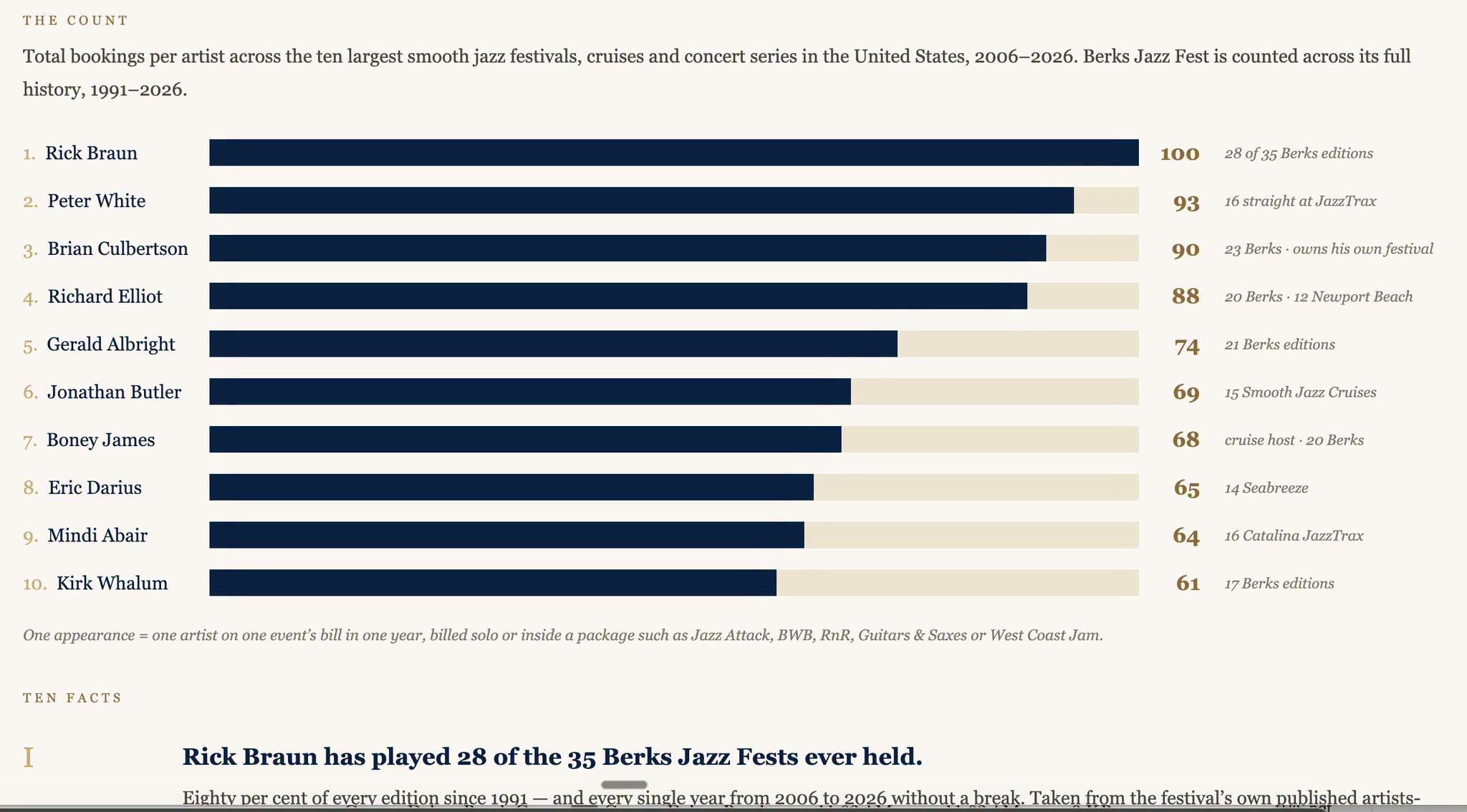
And this isn't one island. Rick Braun's 80%-plus numbers are at other promoters: Florida Smooth Jazz Weekend, 11 of 12 editions (92%, ten in a row 2017–2026). Berks Jazz Fest, 28 of 35 (80%). Daytona Jazz Weekend, 5 of 6 since 2022. Yosemite Jazz Train, 5 of 6. Across the ten largest events in the study, Rick has 100 appearances — the most of anyone. Peter White is second at 93. There are 309 artists who've played Catalina alone. Two guys have more festival slots than most of them will see in an entire career, combined. The cartel isn't a theory. It's a CSV.

Here's the whole ledger.

915 artist-slots across 38 editions. 309 different artists. That's 2.96 bookings per artist — the highest density of any festival in the study. Not high. The highest.

66.5% of every slot in that festival's history went to someone who had already played it. Across the last ten editions, that climbs to 72.1%. It isn't loosening. It's tightening.

Meanwhile 158 artists — 51.1%, more than half of every human being who has ever walked onto that stage — played exactly once and were never asked back. Thirty-eight years of "discovering new talent," and the discovery comes with a one-night return policy.

The admission price for a bill that's three-quarters reruns: $100 for a full weekend in 1991, up to $557.90 in 2026. Five and a half times the money for the same names. And no ticket price was published anywhere from roughly 2004 through 2025 — which is not what a man does with a number he's proud of.

And here's the part that turns this from an opinion into a mechanism.

Art Good has hosted the syndicated JazzTrax radio show since 1985. He founded the festival in 1987. He told the LA Times in 1991, in his own words, that he "wouldn't need advertising because I could announce it on my syndicated show." His site rates records by JazzTrax airplay and drops festival booking plugs into the reviews. His own annual awards become the next year's bookings.

So: he plays the record. He rates the record. He gives it an award. He books the artist. He sells the ticket. Then he points at the room as proof the artist was in demand.

He is the station, the review, the award, the lineup, and the box office. The only job in that building he hasn't given himself is playing the horn.

Then, within days of my last post, the man was out there posting like a hostage, frantically promoting every new act on this year's bill — which I support. Genuinely. A festival that showcases its community and gives new artists a real place to stand is the entire point of this exercise. It's just unfortunate it took thirty-nine years to arrive at it, and that not one of those numbers bothered him until somebody else published them. The reform is good. It's a shame it came from exposure instead of conviction.

So, back to the threat. I will not be at the festival. Devastating. A crushing blow delivered by a man who has never once booked me and spent over a decade ignoring my professional emails — though I notice he found Messenger just fine. What are you gonna do, Art? Not hire me some more? Un-ignore my emails? That's not a blacklist, that's a status update.

And none of this is on the artists. Every one of these players is world class and took a gig they were offered. Nineteen different artists have played that festival ten or more times. Thirty-eight years of JazzTrax, and based on the data, the "Trax" is doing an awful lot of work as a plural.

I fully support Art's constitutional right to use my press kit — and everyone else's — as digital kindling set each year. Nobody owes me a thing, to be clear. Hiring the same people on a loop is the American capitalist dream, and I applaud his steadfast dedication to the routine. Run it however you like. It's yours. Book your Mindi and Rick and Peter until you and or the sun burn out. Everything evolves eventually, so at least you'll get to witness one last historical era before you become a museum exhibit yourself. You've got a few good years left. Why not spend them giving some NEW artists a shot instead of rebooking the same five.

Consider this a community service announcement. Do what you like Art - just don't call it a festival In a sense of what the rest of the community considers a community festival. Nineteen names with lifetime privileges, a hundred and fifty-eight one-night guest passes, and a door that opens exactly once, for the photo. That's a country club. You're not serving the music. You're not serving the community. You are not serving the arts. You aren't serving the future of the music and frankly you're not even serving your sponsors. I'm sure even they see it.

And here's the concept you're going to hear me repeat, because there's mythology to break through. When you book the same artist 10, 20, 30 times on major stages, you are not catering to demand. You are MANUFACTURING it. Demand didn't build that lineup — that lineup built the demand. Put the same names in front of an audience for thirty years and the audience learns those are the names. Then that gets held up as proof you were right all along.

That's not a market. That's a racket.

Everybody see it. The end.

https://festivalstats.netlify.app/catalina

Back to the index

The Catalina Files · 3Oct 5, 2026 · 7:06 PM · 5 min read

Breaking News from Catalina Island

Opening night of the 2026 JazzTrax Festival is… Peter White. For the 23rd time.

Brace yourselves. Opening night of the 2026 JazzTrax Festival is… Peter White.

I know. I KNOW. Nobody saw it coming. For the 23rd time.

Thank God. I was getting worried. It had been almost a whole year since I'd been offered a Peter White concert. The withdrawal was setting in. I was shaking. I almost listened to somebody new by accident.

Let's walk through the miracle.

Peter debuted on Catalina in 1991. For his first twelve years he played every other year: 1991, 1993, 1995, 1997, 1999, 2001, 2003. Like a smog check. Then somebody decided once every two years wasn't enough Peter, and they made it annual. He played 2006 through 2010, then 2012, 2013 and 2014, then six straight from 2016 through 2022, then 2024. And now 2026, opening Thursday.

That's 23 appearances. That's 61% of every edition the festival has ever held, and 68% of every edition since he showed up. He's played eight of the last ten and sixteen of the last twenty. Art proudly points out on his own website that Peter has only missed two in the last decade. Art, that's not the flex you think it is. That's a lease.

And don't panic if you miss him on the island. The man is EVERYWHERE.

  • BMG Concerts: 17.
  • Florida Smooth Jazz Weekend: 11. Every year since 2015 but one.
  • Grooves at the Westin: 8.
  • Daytona Jazz Weekend: 7. Every year since 2021, and already booked for 2027, in case you were nervous.
  • Newport Beach: 7.
  • Yosemite Jazz Train: 5. Every year since 2022. It's a steam train in the Sierra, and somehow Peter's the one who's always on schedule.
  • Rick Braun's New Year's Eve: 4 years straight. New Year's Eve. The one night of the year that is literally about something NEW.
  • San Diego: 3. Clearwater: 2. Gulf Coast: 2. Grooves in the Grove: 1.
  • And four Christmas shows. Even Santa takes a year off.

That's 83 festival slots under his own name across 12 different series, or 90 if you count the Christmas shows and group packages. Number one in the entire study. Not number one on the charts. Number one in getting booked. Cal Ripken is somewhere taking notes.

So how does a guy get 23 Catalinas? Meet Art Good.

Every great festival has a visionary behind it. Catalina has a guy who really, really wanted to be in the band.

Some men want to play the saxophone. They practice. Forty years of long tones. Some men want to play guitar. Calluses, scales, bad gigs, worse motels.

And some men skip all of that and buy the stage.

Art didn't learn the instrument. He learned the next best thing: how to stand next to the people who did. Every October, for thirty-nine years, he has a microphone in his hand and his name on the poster in a bigger font than theirs.

And it's honestly genius. Can't get into the band? Become the radio show that plays the band. Then become the critic who rates the band, from one star to five, "Light JazzTrax Airplay" to "Heavy JazzTrax Airplay." Then become the awards committee. Who won JazzTrax Album of the Year for 2025? Peter White. And who's opening the 2026 festival? Peter White. Then become the festival that books the band. Then give your own festival the award for Best Live Performance of the year. That's like Mom entering her own pie in the county fair and taking the blue ribbon.

He's not a promoter. He's a one-man industry: the station, the review, the trophy, the lineup and the box office. At his company he's listed as CEO, secretary, CFO, director AND registered agent. Five titles. One guy. The only job in the building he hasn't given himself is the one he actually wanted.

And yes, Peter's Thursday has been sold out since August. Proof of demand! Absolutely. My dentist is in high demand too. He's the only one my insurance covers.

Here's how it works. Play the record on your show for thirty years. Put the same name on the poster 23 times, and the audience learns to buy the poster. Then point at the sold-out sign and say, "See? They love him." That's not demand. That's a habit somebody built on purpose.

Meanwhile, 66.5% of every slot on that island has gone to somebody who already played it, and 72% over the last ten years. Nineteen artists have ten or more appearances. That's not a talent search. That's a standing tee time. And 158 artists played that island exactly once and never got the call again. One night. Photo op. Thanks for coming. Here's your souvenir lanyard.

Now let's talk about that word on the poster. FESTIVAL.

A festival is supposed to be a front porch for the music. It's where a kid with a secondhand horn gets to stand twenty feet from a legend and think, "That could be me." It's where the next great player gets discovered, not tolerated for one night and sent home. It's where the community comes together, the local players get a real stage, and the music gets handed forward to the people who will carry it next. A festival is supposed to encourage creativity, take a risk, surprise you. It should introduce you to somebody you've never heard of, who becomes somebody you'll never forget.

Catalina doesn't have a front porch. It has a guest list. Same names on the door since the first Bush administration.

New artists? Sure. One night, early slot, no return ticket. Discovery with a one-way policy.

Community? The community is invited to buy a ticket and watch the same friends play the same slots.

Creativity? The most creative thing on that island is the explanation for why it's Peter White again.

So let's call it what it actually is: The Peter White Residency, Presented by the Art Good Fan Club, With Special Guests Who Will Not Be Asked Back.

That's not a festival. That's a timeshare with a horn section.

Love Peter. Great player. Lovely guy. Not the point. The point is there are hundreds of world-class artists who would kill for ONE of those 83 slots, and the door is welded shut.

Art, I get it. Truly. You love this music. You wanted to be up there. So you built a little world where every year you get to walk out, take the mic, introduce your friends, and feel like you're part of the band. That's sweet. But a festival is supposed to be about the music, the community and the future of the art. This one is about the guy holding the microphone.

You want to play? Pick up a horn. I'll give you a lesson. Free. It's more than you ever gave me.

But hey. What this country really needs right now is another Peter White concert, presented by Art Good. Everybody's been waiting.

All of them. Since 1991.

festivalstats.netlify.app

Back to the index